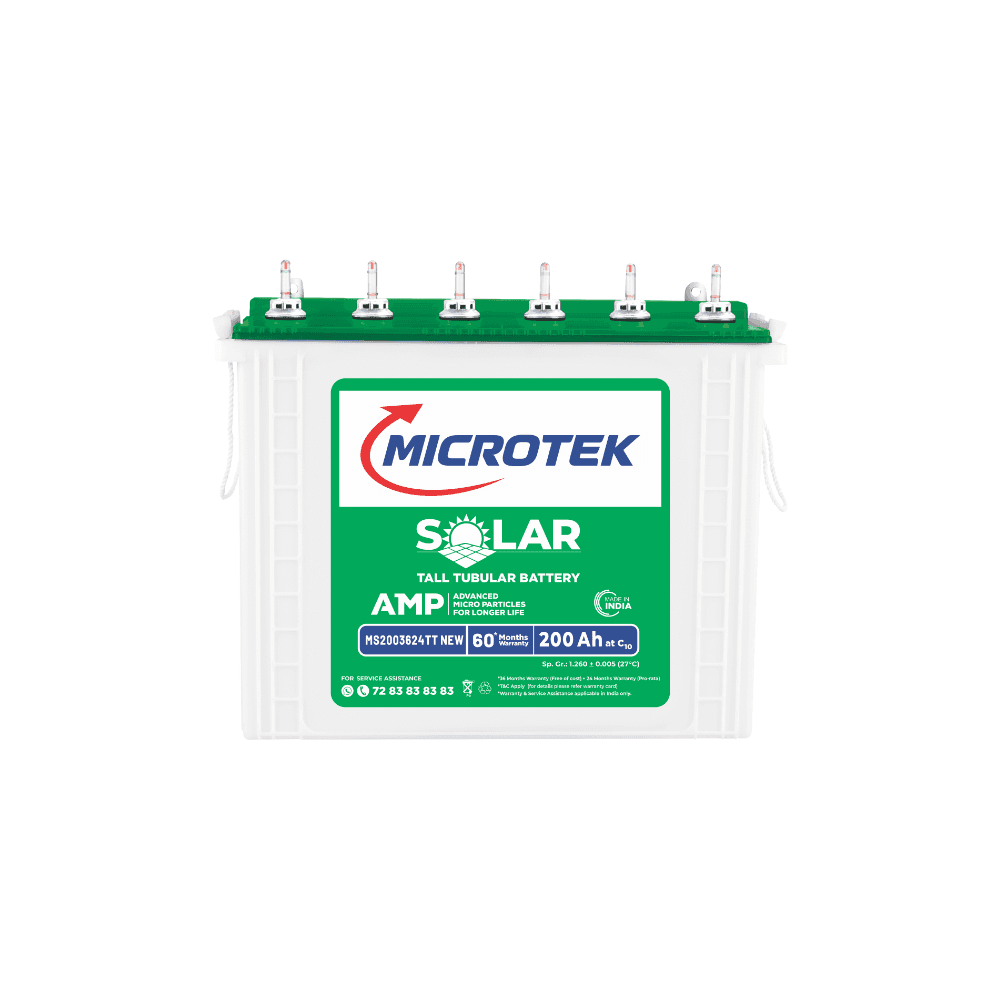
Solar duty is the hardest duty a battery does
A backup battery is cycled when the power fails. A solar battery is cycled every single day by design — charged through the day, discharged in the evening, year after year. That is a fundamentally harder life, and it is why a battery that gives good service on a backup-only inverter can disappoint on a solar system.
The consequence for buying: cycle life matters more here than headline capacity, and the bank should be treated as a component with a service life rather than a one-time purchase. Sizing the bank so that the daily discharge is shallow rather than deep is the single most effective thing you can do to extend it.
Sizing for one evening, with margin for a bad day
Work from the evening load you want to carry and the hours you want to carry it, then add margin for the days the sun does not cooperate — a stretch of monsoon cloud or January smog. A bank sized exactly to a perfect day will be run deep on every imperfect one, which is precisely the abuse that shortens its life.
Remember also that usable capacity is well below nameplate for lead-acid: planning around roughly 60% depth of discharge is what protects the bank. A quote that computes runtime from the full nameplate figure is overstating what you will actually get.
Voltage is dictated, capacity is chosen
The bank voltage must match what your PCU, SMU or inverter expects — 24V, 48V and upward — and that determines how many 12V batteries are wired in series. You do not get a choice there. What you choose is the Ah of each unit, which sets how much energy the bank holds.
Every unit in the bank should be the same capacity, the same type and the same age. Adding one new battery to an aged bank does not restore it: the new unit is held back by its weaker neighbours and the old ones fail shortly afterwards anyway. Replace a bank as a matched set.
Where lithium changes the arithmetic
Daily cycling is exactly the case where LiFePO4's cycle life earns its higher price. A lead-acid bank cycled every day is consumed considerably faster than the same bank on standby duty, so the replacement interval — not the purchase price — dominates the ten-year cost of a solar system.
That does not make lithium automatically correct. It is gated on whether your inverter or PCU supports a lithium charging profile, and on your budget today. But for a system that will cycle every evening for a decade, the comparison worth running is cost per year across the whole period, not the price on the invoice.